
Gelco Chimney Sweep in Stapleton: A Homeowner’s Guide
If your chimney has a galvanized chase cover that’s rusting at the seams, there’s a reasonable chance it’s a Gelco unit, and the replacement decision isn’t just about matching the brand. Gelco caps, chase covers, and top-sealing dampers were specified on a lot of homes around Stapleton and the rest of Staten Island, so plenty of homeowners are living with one and have no idea what they’ve got up there. This guide is about reading that component honestly: when it’s still serviceable, when it’s finished, and when matching the brand is the wrong move. If you’d rather not climb up to squint at it yourself, call (866) 280-5786 and we’ll take a look.
What Gelco Actually Makes (And What’s Probably On Your Roof)
“Gelco” gets used loosely, so let’s be precise about what you’d find on a Stapleton chimney. Gelco manufactures chimney caps, chase covers, and dampers, and those are the pieces that show up on this housing stock. A chimney cap sits on top of a masonry flue and keeps rain, birds, and squirrels out while letting smoke escape. A chase cover is the flat lid over a prefab or framed chase, the boxed enclosure on the outside of the house. A damper is the plate that seals the flue when the fireplace isn’t in use. These are three different jobs with three different failure modes, and homeowners regularly confuse them.
How to identify a Gelco component from the ground:
- Look at the metal. Galvanized steel has a dull, spangled gray finish. Stainless is brighter and more uniform. Galvanized rusts at cut edges and seams first.
- Look at the seams. A fabricated chase cover has folded or riveted corners. Those corners are where water gets in.
- Look for a manufacturer stamp or label. Some caps carry a small tag on the inside flange. You often need to be up close to read it.
- Check the shape. Multi-flue caps with a rectangular footprint and louvered sides are common. A single round cap over one flue is a different animal.
We handle chimney cap & crown work on all of these, which matters because the part you see from the driveway is only half the story. The crown, the masonry slab the cap sits on, is where a lot of water damage actually starts.
Is Your Gelco Cap or Chase Cover at End of Life?
A galvanized Gelco chase cover is at end of life when rust has eaten through the metal or opened a seam, not when the paint has chalked. Surface discoloration and light rust bloom are cosmetic. Pinholes, flaking sheets, a soft spot you can push through, or water staining on the ceiling below the chase are the real signals. Any one of those means it’s time to plan a replacement rather than keep resealing it.
Here’s how to sort serviceable from finished:
- Serviceable: intact metal, tight seams, rust confined to the surface, no water inside the chase. A cleaning and a proper reseal with a suitable sealant buys real time.
- Borderline: rust creeping along the folded edges, sealant failing at the corners, but the panels are still solid. Reseal and watch it; plan for replacement.
- Finished: perforation, separated seams, standing water in the chase, or a cover that’s lifted or shifted. Resealing a compromised cover just traps moisture against the framing.
In Stapleton’s climate, the freeze-thaw cycle is the enemy. Water works into a seam, freezes, expands, and opens it a little wider each winter. That’s why a chase cover that looks fine in July can be leaking by February. If you’re unsure which category yours falls into, that’s exactly the call we’d rather get early.
Replace In-Kind or Upgrade to Stainless? A Straight Comparison
Replacing a Gelco component in-kind makes sense when the original did its job for a long time and the rest of the chimney is sound. Upgrading to stainless steel or a heavier gauge makes sense when the cover sits in a spot that gets hammered by weather, when you’ve already replaced a galvanized unit once, or when you’re sealing up a chase that has a history of water intrusion. Both are legitimate answers. The honest one depends on what’s failing and why.
- Galvanized (in-kind): lower material cost, adequate protection, shorter service life. Reach for it when budget is the deciding factor and the exposure isn’t severe.
- Stainless steel: resists rust and staining far better, holds up to years of freeze-thaw, costs more up front. The right call on a cover that’s already failed once.
- Heavier gauge: less oil-canning and flexing, better at shedding water off seams. Worth it on larger chase footprints where a thin panel sags.
When we replace a cover, we’ll often reach for Famco or Olympia Chimney components rather than a generic piece, because the gauge and the seam design are what actually keep water out. We say that not as a knock on Gelco, but because the failure you’re fixing usually comes down to material and build, not brand loyalty. The right repair, not the most expensive one, is the standard we work to. For deeper structural issues around the firebox, our fireplace repair service covers that side of the chimney.
Why Gelco Chase Cover Sizing Trips Up DIY Buyers
The most common homeowner error when sourcing a replacement cap or chase cover on their own is buying the wrong dimensions. A cover has to overhang the chase framing far enough to shed water clear of the siding, sit square on the framing, and account for the flue or flues passing through it. Ordering to the “outside” measurement instead of the framing measurement, or forgetting the overhang, produces a cover that either won’t seat or channels water straight down the walls. It’s a costly mistake, and it’s the kind that doesn’t show up until the first hard rain.
Getting sizing right means measuring in the right places, in the right order:
- Measure the chase framing, not the old cover, at the top and at the bottom (chases aren’t always square).
- Note the overhang you need on each side so runoff clears the siding.
- Measure each flue’s outside diameter and confirm pipe centering.
- Check for a crown or trim that the cover has to sit over or around.
Our technicians have up to 11 years of experience with this, and we’ve watched enough oversized and undersized covers come through Stapleton to know the measurements that get skipped. It’s a short list of numbers, but they have to be the right ones.
What a Professional Sweep Sees That You Can’t From the Ground
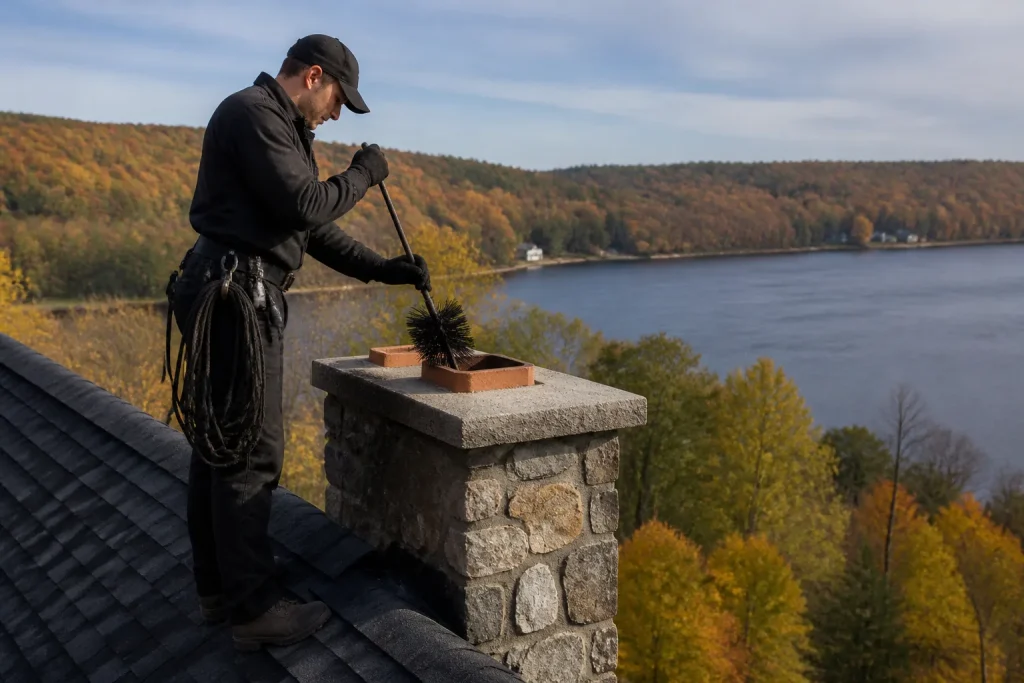
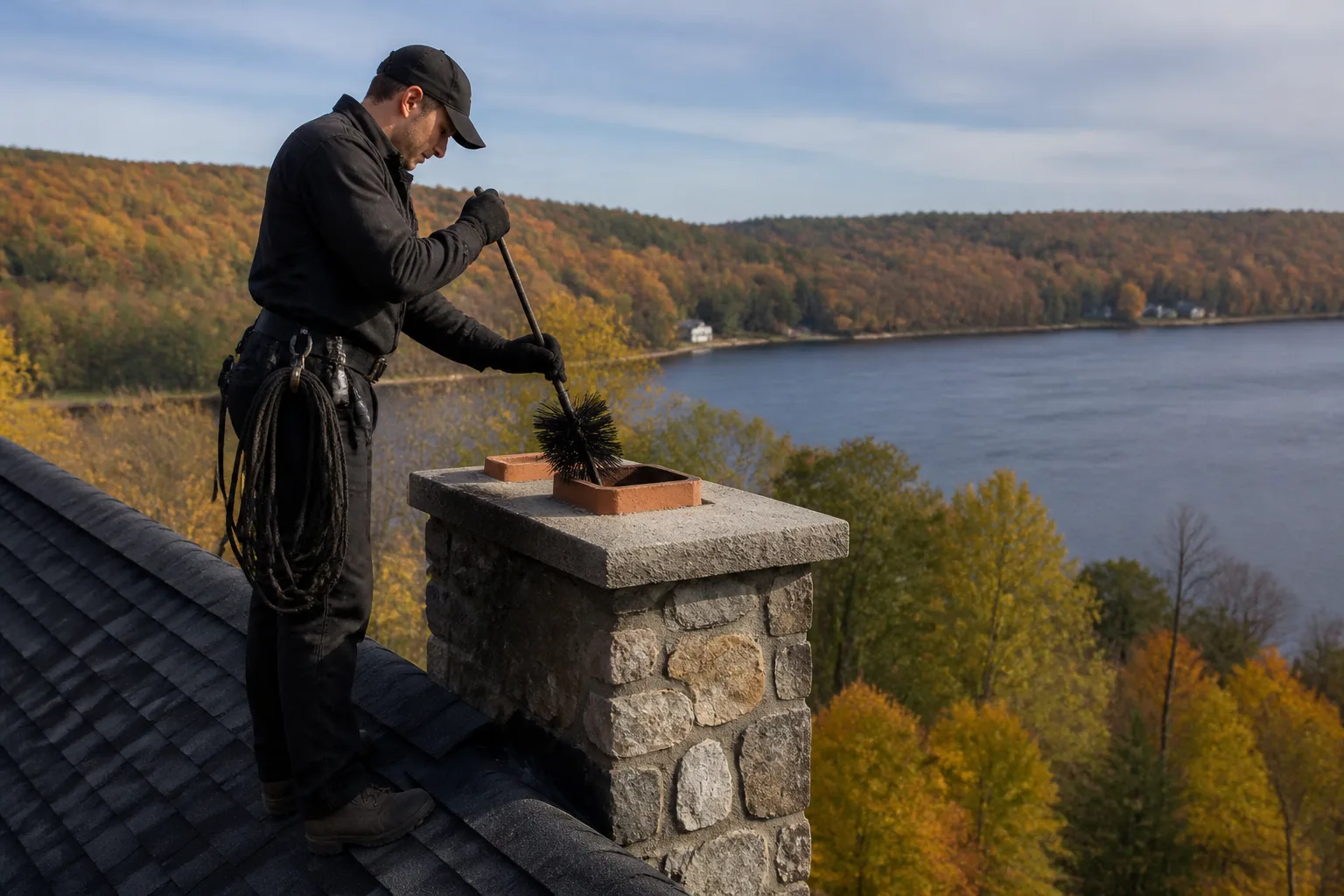
A sweep’s role in assessing a Gelco component isn’t just spotting it, it’s judging whether it’s still doing its job. Some things are visible from the driveway: obvious rust, a lifted cover, a cap that’s off square. Most of what matters isn’t. Seam integrity on the underside, water tracking into the chase framing, the condition of the flue liner beneath the cap, and whether the damper still seals all require a physical inspection, and we inspect it before we touch it. That’s our standard protocol, not an add-on.
What needs eyes on it versus what doesn’t:
- Ground inspection: rust bloom, missing caps, obvious tilt, vegetation in the flue, bird activity.
- Physical inspection: seam condition underneath, chase framing moisture, flue liner integrity, damper operation, crown cracks.
The documented inspection is also worth having for its own sake. Insurers and real-estate transactions often want a baseline record of the chimney’s condition, and a photo you took with your phone won’t carry the same weight. On the sweeping side, a proper chimney sweep goes far beyond clearing soot; it’s a full read on whether the appliance is drafting safely. If you want the full rundown of what we do, the Chimney Sweep Stapleton page covers it. And a light note on the danger side: we don’t recommend anyone climbing onto a steep, icy roof to inspect a cap. It’s a trained-professional job, and we’re happy to be that call.
When to Call a Pro (and What to Say)
Call a professional when you can’t identify the component from the ground, when you see rust-through or separated seams, when water is showing up below the chase, or when a sweep, inspection, or replacement is coming up and you want it done once, correctly. You don’t need a diagnosis in hand before you call. Bringing a photo of the roof if you can get one safely helps, but it isn’t required.
We answer 24/7. Fast dispatch from 7am to 7pm, Sunday through Friday. When you call (866) 280-5786, we’ll ask a few questions about the chimney, book an inspection, and take it from there. We can work with your insurer on documentation, and we’ll tell you plainly if the work can safely wait, because a recommendation without evidence you can see is a recommendation you shouldn’t trust. Our technicians are experienced across the full range of Gelco and other cap and chase work, and if a stainless upgrade is what your Stapleton chimney really needs, we’ll say so.
The Bottom Line
A Gelco cap, chase cover, or damper on your Stapleton home is either working, borderline, or finished, and the difference between the last two usually comes down to rust-through and seam condition you can’t fully judge from the ground. Cleaning and resealing a solid component is smart; resealing a perforated one just traps water. Replacing in-kind is fine when budget drives the decision and exposure is mild; upgrading to stainless or heavier gauge is the better call when a cover has already failed once. And sizing a replacement correctly is the step DIY buyers most often get wrong, because a cover has to be measured to the chase framing, not the old part. If you’re in Stapleton and want a straight answer on what you’ve got and when it needs replacing, Chimney Sweep Stapleton offers free estimates. Call (866) 280-5786.
Frequently Asked Questions
Look for a small manufacturer tag on the inside flange and check the metal finish: a dull, spangled gray points to galvanized steel, which is the most common Gelco material. If you can’t identify it safely from the ground, an inspection settles it. Call (866) 280-5786 for a free estimate.
Yes, if the metal is still intact and the rust is surface-level; cleaning and resealing buys real time. Once there’s perforation or separated seams, resealing traps moisture and replacement is the correct move. We’ll tell you which you’re dealing with after we inspect it. Call (866) 280-5786 for a free estimate.
Match the brand in-kind when the original lasted well and budget is the driver; upgrade to stainless or a heavier gauge when the cover sits in harsh exposure or has already failed once. The right answer depends on why it failed. Call (866) 280-5786 for a free estimate.
Because a cover that doesn’t overhang the chase framing correctly either won’t seat or sends water down the siding. Measure the framing, not the old cover, and account for overhang and flue diameter. If you’re unsure, an inspection covers it. Call (866) 280-5786 for a free estimate.
Written by the team at Chimney Sweep Stapleton.
Need Chimney Cleaning Help?
Call Chimney Sweep Stapleton - the local pro we connect you with is licensed and insured, with free written estimates in Stapleton.
(866) 280-5786